

Normalcy bias is a cognitive bias which leads people to disbelieve or minimize threat warnings. Consequently, individuals underestimate the likelihood of a disaster, when it might affect them, and its potential adverse effects.
Normalcy bias in geopolitics
Last year on Twitter, I wrote about how major military escalations never unfold based on rational considerations, but are rather the result of irrational processes that ultimately fall beyond the control of decision-makers.
I illustrated this point at the time using the example of the Cuban Missile Crisis.
Anyone who reads history knows that in times of crisis, political communication has always been full of self-deception, the denial of the situation’s severity, and disinformation-war.
Let me share two examples from the period preceding World War I.
In the first attached image below, you can see a French article from August 1914 arguing that modern wars (meaning those of a century ago) would be less lethal than previous ones.
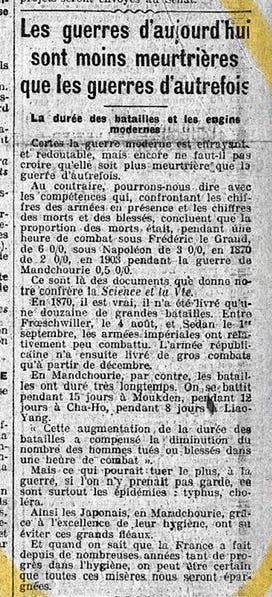
The analyst claimed that this fear merely stemmed from an ignorance of technology, and conversely, that humanity had learned its lesson from past conflicts. They also added that authorities were much more capable of combating war-related epidemics than before, meaning there was no cause for concern on that front either.
In the very days this article was published, the most devastating war in history up to that point began to escalate, and in its final year, the deadliest pandemic in human history—the Spanish flu—broke out.
The second image below features an excerpt from the German ambassador’s telegraph correspondence with the United States, expressing his optimistic views on conflict management in August 1914.
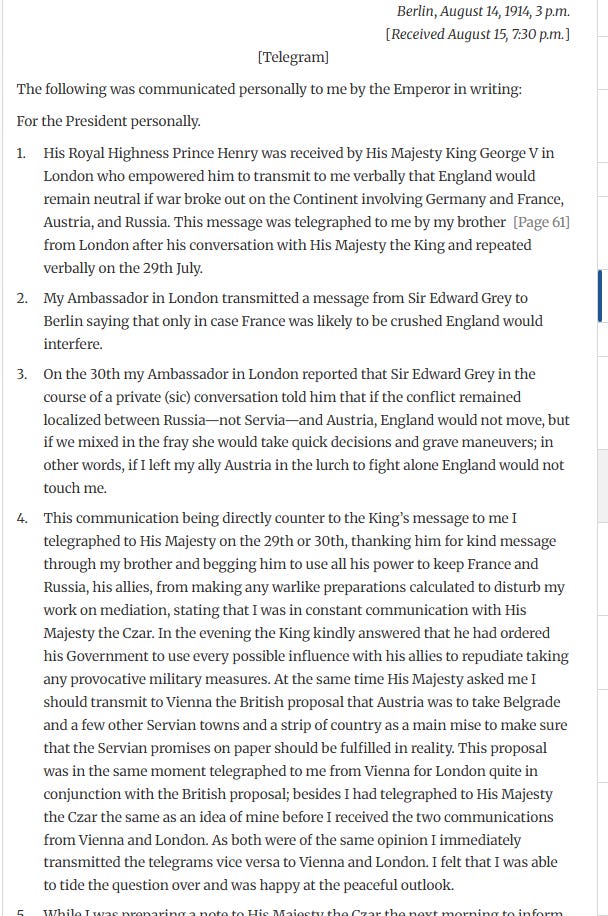
Regarding these diplomatic efforts, Christopher Clark writes the following in his book, ‘The Sleepwalkers’:
‘In the first days it still seemed quite easily imaginable that the crisis would be resolved quickly. Wilhelm II told Emperor Franz Joseph on 6 July that ‘the situation would be cleared up within a week, because of Serbia’s backing down...’, although it was possible – as he noted to Minister of War Erich von Falkenhayn – that the ‘period of tension’ might last a little longer, perhaps ‘three weeks’. The political leadership maintained even in the third week of July – when the hope of a quick resolution no longer seemed realistic – that the conflict could be localized. On 17 July, the Saxon chargé d’affaires in Berlin learned that ‘a localization of the conflict is to be expected, since England is absolutely peaceable and neither France nor Russia appears to feel any inclination for war.’
Barely a month later, Europe was in flames.
The third image below shows the words of the Russian Foreign Ministry spokeswoman, stated barely two weeks before the invasion of Ukraine.
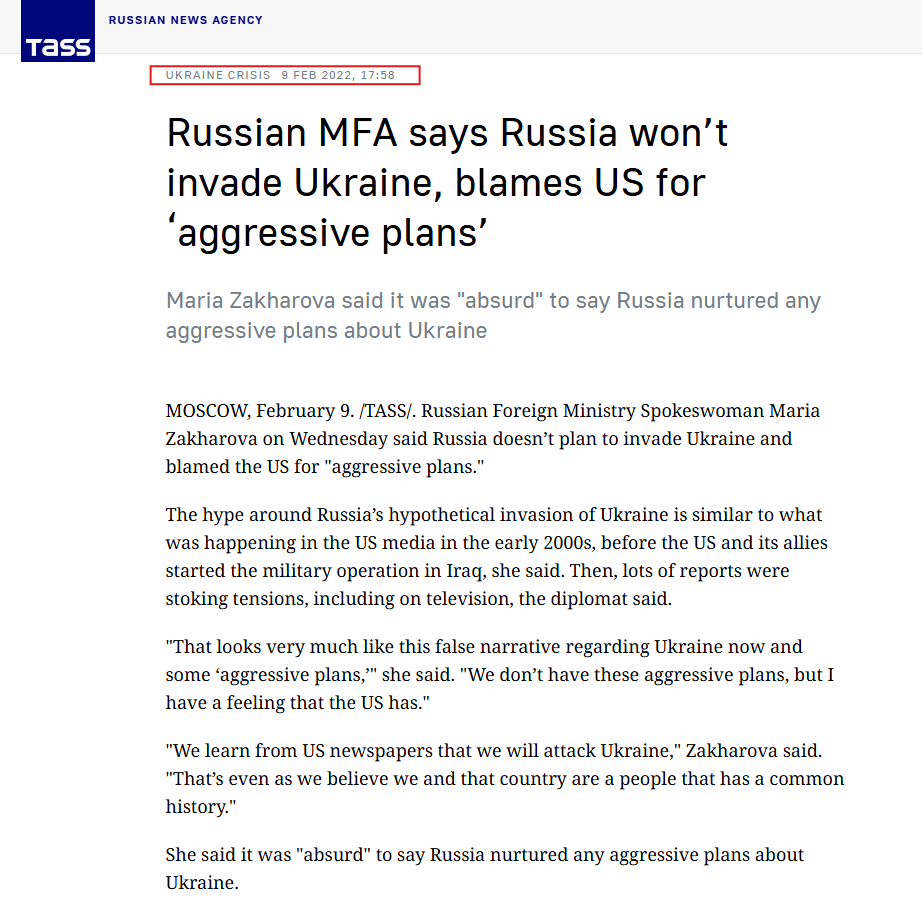
(I would add that Zelensky didn’t believe the intelligence services either — not until the first explosions.)
I have addressed Russia’s geostrategic diplomacy-games on several occasions. We all saw these patterns many times. And back then, only Churchill saw through Hitler’s real plans and geostrategic maneuvers at the Munich Conference. He criticized Chamberlain’s deal sharply: “We have suffered a total and unmitigated defeat... And do not suppose that this is the end. This is only the beginning of the reckoning.”
All while, China is also clearly preparing for war against the West — a conflict that Trump is trying to prevent by regaining control of NATO's strategic points. This is exactly why Venezuela, Iran, Greenland, and the others happened.
Since the Middle Ages, almost every aggressor has campaigned with messages of peace and divine mission, portraying themselves as the victim and the attacked party as the aggressor, thereby gradually gaining various diplomatic advantages over their pre-chosen victims.
I highly recommend the following interview with John Sipher to everyone’s attention:
He worked for 28 years as an intelligence officer in operational roles, holding senior leadership positions for much of that time — for example, as the head of U.S. CIA operations in Moscow — and was also a member of the CIA’s executive leadership council. He is one of the most serious professional authorities in this field who is willing to engage publicly.
Normalcy bias in the markets
A similar normalcy bias manifested prior to the Great Crash of 1929, when the ‘New Era’ theory emerged in the financial world.
Irving Fisher, the star economist of Yale University, wrote: ‘Stock prices have reached what looks like a permanently high plateau. I do not feel that there will soon, if ever, be a fifty or sixty point break below present levels, such as Mr. Babson has predicted. I expect to see the stock market a good deal higher than it is today within a few months’
Charles E. Mitchell, the president of Citibank at the time, wrote just two days before the onset of the crash: ‘I know of nothing fundamentally wrong with the stock market or with the underlying business and credit structure. [...] The public is suffering from ‘brokers’ loanitis’
And the Harvard Economic Society wrote the following roughly a month and a half after the market’s first downside wave: ‘The present recession, both for stocks and business, is not the precursor of business depression. A severe depression like that of 1920-21 is outside the range of probability. We are not facing protracted liquidation.’
Same thing played out during the dot-com era and the 2008/09 crisis…
Furthermore, ever since Powell’s ‘this time is different’ remark last year, the market has been trading sideways and consistently losing value when measured in euros or yuan, for instance:
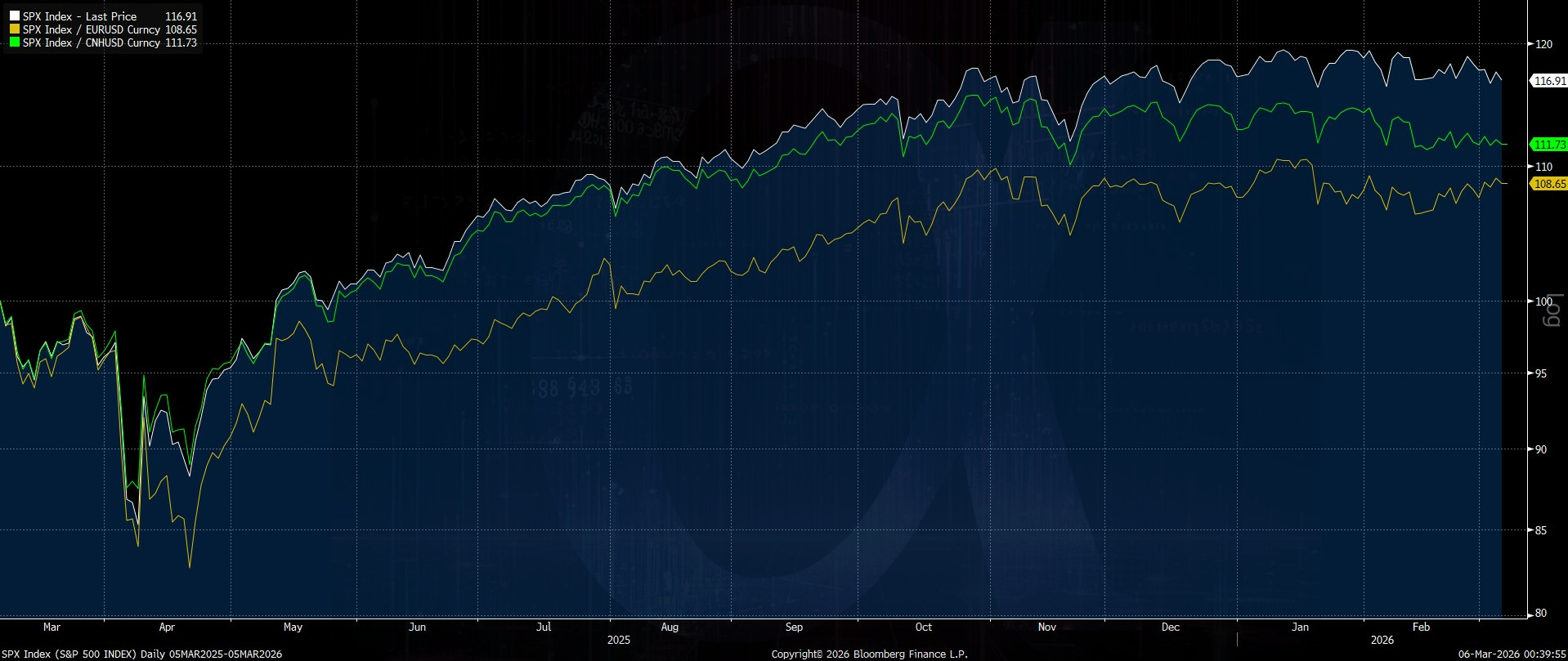
In my January post, I wrote about the tech: “The same pattern played out in the 1920s with radio and aviation, and during the dot-com bubble with the infrastructure built around the internet. In both cases, the core issue was excess capacity and excessive credit creation. Just because an innovation is useful does not mean it cannot be overvalued: demand grows slowly, and it does not grow without limit. In addition, supply chains have always had to adapt to natural constraints, social and geographic realities, and broader economic disruptions. Over the long run, only those technologies survive that solve more problems than they create.”
The takeaway: never believe anything until it has been officially denied by the Kremlin, the Chinese President, or the Fed.
I have compiled the geopolitical analyses I posted on Twitter over the past year and a half into the ‘Highlights’ section of my profile.
Also, you can find free insights in this Substack’s free section including Iran, Greenland, Venezuela, East-West conflict. And I’m planning to write a summary post.
Please take the time to read them.
There is a reason I wrote them, and I did so well in advance…